



 Khaled Azar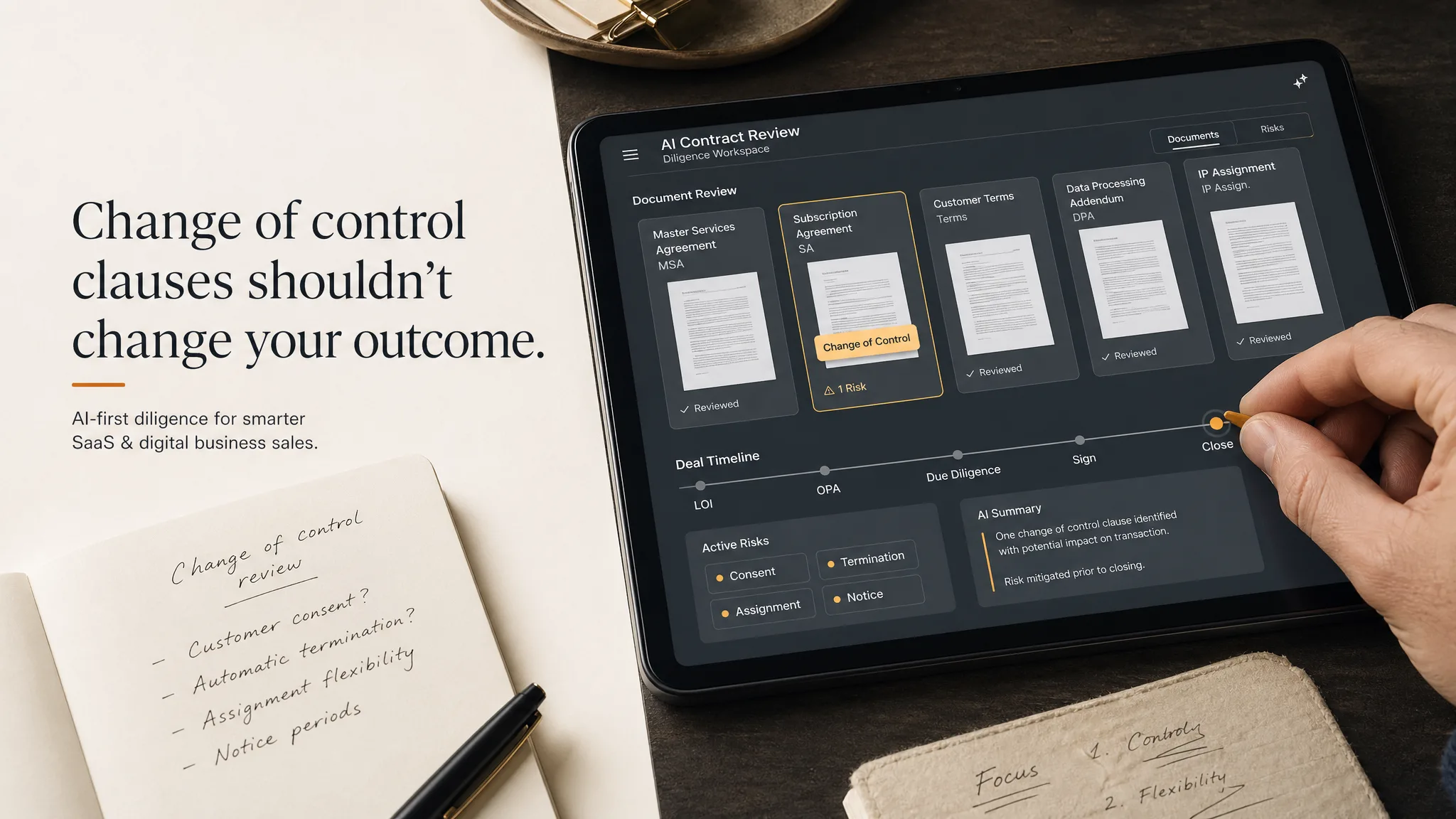
A change of control clause in a business sale can require customer, vendor, lender, or licensing consent before a deal closes. For SaaS sellers, the risk is simple: a contract that looks active in your revenue schedule may not transfer cleanly to the buyer.
Most founders do not look for these clauses until diligence starts. Buyers do. If a large customer, platform partner, or software license can terminate when ownership changes, that clause moves from legal wording to deal value very quickly.
Many change of control definitions are triggered when more than 50% of voting equity changes hands, though thresholds can vary by contract and transaction type.
What a Change of Control Clause Does
The clause tells you what happens when ownership changes, even if the contract itself stays in place.
A change of control clause defines a trigger and a consequence. The trigger might be a stock sale, merger, asset sale, board change, or transfer of a controlling ownership interest. The consequence might be notice, consent, termination rights, payment acceleration, or a pricing reset.
ContractKen’s change of control overview describes the common trigger categories as equity transfers, mergers, asset sales, board composition changes, and management changes. That breadth is why sellers cannot rely on the transaction label alone.
In a stock sale, the legal entity may remain the same. But the counterparty may still have a right to consent because the owner changed. In an asset sale, assignment restrictions may matter even more because the contract itself may need to move to a new entity.
Why Buyers Care About These Clauses
Buyers care because contracts are part of the asset they are buying. If a customer agreement, vendor agreement, data license, payment processor agreement, hosting agreement, or debt facility can be terminated at closing, the buyer has to underwrite that risk.
For SaaS companies, the highest-risk contracts are usually not random boilerplate. They are the agreements tied to revenue, product delivery, data rights, infrastructure, payments, and regulated workflows.
| Contract type | Why it matters | Seller action |
|---|---|---|
| Top customer agreements | Revenue may depend on consent or renewal. | Identify consent triggers before LOI. |
| Vendor and platform agreements | Product delivery may depend on third-party services. | Confirm assignment and change rules. |
| IP and data licenses | Core rights may not survive a buyer transition. | Review termination and use restrictions. |
| Debt agreements | Ownership change can trigger default or repayment. | Coordinate payoff and lender consent early. |
This is why a clean M&A data room preparation checklist should include more than signed contracts. It should include a consent tracker, contract owner, renewal date, change of control language, and recommended outreach plan.
Change of Control Is Not the Same as Assignment
Founders often combine change of control and assignment in their heads. Buyers separate them.
An assignment clause governs whether a contract can be transferred to another party. A change of control clause governs what happens when ownership or control of a party changes. The distinction matters because a stock sale may not technically assign the contract, but it may still trigger a change of control consent right.
Law Insider’s sample language shows how assignment and change of control concepts often appear together. Some clauses require notice. Some require prior written consent. Some say an unauthorized transfer is null and void.
How Sellers Should Prepare Before Diligence
Start with your top 20 contracts by revenue, product dependency, or deal sensitivity. Do not wait for the buyer’s counsel to find the issue first.
Create a simple tracker with five fields: counterparty, contract type, change of control trigger, consent requirement, and practical risk. Then rank each contract as low, medium, or high risk.
High risk means the counterparty has consent, termination, repricing, or operational control that could affect closing. Medium risk means consent may be needed but the relationship is strong. Low risk means the contract allows transfer or change of control without meaningful restriction.
The timing matters. If a key consent is required, you usually need a plan before signing exclusivity. Once you are locked into one buyer, a third party can use consent as a negotiation point.
The goal is not to eliminate every consent issue. The goal is to know which clauses can affect value, timing, or closing certainty before the buyer turns them into a retrade.
How This Shows Up Between LOI and Close
After LOI, change of control issues usually surface during legal diligence. The buyer’s counsel reviews material contracts, marks consent requirements, and asks the seller to explain how each one will be handled.
If the issue is small, it becomes a closing checklist item. If the issue affects a major customer, core vendor, or critical license, it can affect purchase price, escrow, closing conditions, or whether the buyer proceeds at all.
That is why the period between LOI and close is not just paperwork. It is where hidden contract risk becomes visible. And it is why sellers should address consent issues before they are negotiating from a weaker position.
For negotiated deal terms, this can also connect to how sellers negotiate a letter of intent. If a known consent risk exists, the LOI should not pretend it does not.
Frequently Asked Questions
What is a change of control clause in M&A?
A change of control clause defines what happens when ownership or control of a party changes. It can require notice, consent, termination rights, payment acceleration, or other consequences in a sale.
Does a stock sale trigger a change of control clause?
Yes, it can. Even if the contracting entity remains the same, a clause may treat a transfer of voting control or majority ownership as a trigger requiring consent.
Is change of control the same as assignment?
No. Assignment deals with transferring the contract to another party. Change of control deals with ownership or control changes, even when the original contracting entity remains in place.
When should a seller review change of control clauses?
A seller should review them before going to market, starting with top customer, vendor, lender, platform, and IP agreements. Waiting until diligence can create timing and negotiation risk.
Next Steps
If you are preparing to sell and are not sure which contracts could slow down closing, Livmo can help you identify the consent risks buyers will care about before diligence starts.