



 Khaled Azar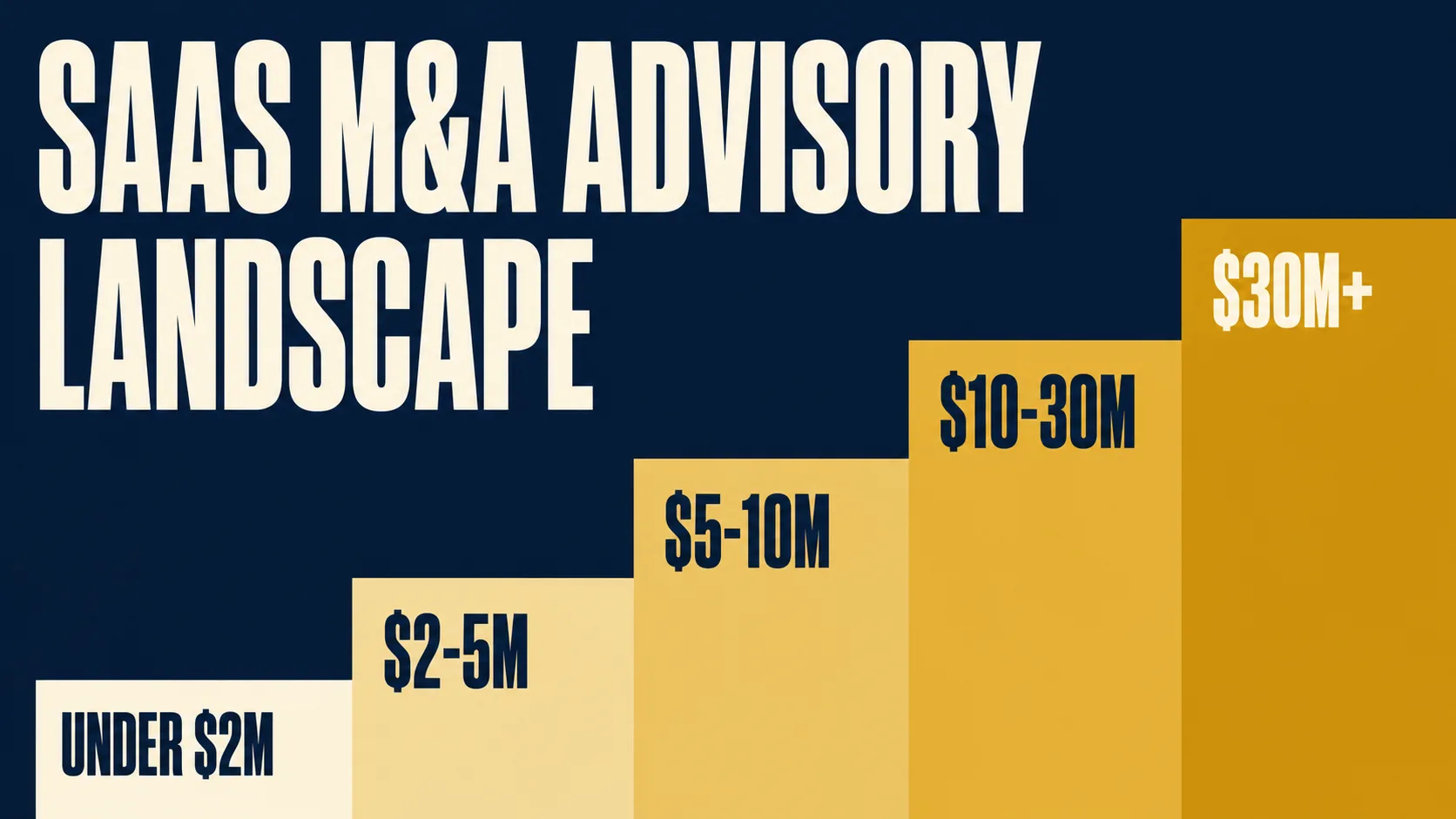
The right M&A advisory firm for a SaaS company is the one whose typical deal size matches your revenue, whose buyers already know your category, and whose partners will still be on your calls in month seven. Most founders pick on brand instead, and brand is the weakest of the three signals.
Updated October 13, 2026. 11 firms scored out of 100 on what each firm publishes, with sources.
This guide scores 11 SaaS M&A advisory firms, including our own, out of 100 on public evidence, groups them by the revenue they serve, and gives you an interview scorecard for the final choice. It also tells you plainly where Livmo fits and where we do not. Choosing the firm is the first real decision in any SaaS exit strategy, and it is the one founders spend the least time on.
Below roughly $2 million in ARR, marketplaces and brokers are the common route. Between $2 million and $30 million, boutique software specialists run a genuine competitive process. Above that, mid market investment banks take over. Fit inside your revenue band matters more than the size of the name on the door. On our October 2026 scores, Corum Group (83), Software Equity Group (81.5) and Vista Point Advisors (81.5) lead the 11 firms we ranked.
Key takeaways
- A SaaS M&A advisor runs a competitive sale process, builds the materials buyers read, contacts buyers in parallel, and negotiates terms. They do not fix a business that is not ready to sell.
- We scored 11 firms out of 100 on public evidence. Corum Group scored highest at 83, and the lowest score was 48.
- Advisory firms are separated far more by deal size than by quality. A firm built for $200 million transactions will not give a $6 million deal its senior people.
- Boutique software specialists are the right category for most founders between roughly $2 million and $30 million in ARR.
- Business brokers and marketplaces suit smaller, simpler businesses. They are a different product, not a cheaper version of the same one.
- Typical sell side economics are a retainer in the low tens of thousands, credited against a success fee that usually lands between 2 and 5 percent of transaction value.
- Vertical experience beats general M&A experience. A buyer list for vertical SaaS looks nothing like a buyer list for developer tools.
- The partner you meet in the pitch should be the partner who runs the process. Ask directly, and ask for references from founders whose deals did not close.
- A full sell side process runs 6 to 12 months from first preparation to wire transfer.
What a SaaS M&A advisor actually does
Four jobs, and one important thing that is not on the list.
A sell side advisor does four things. They prepare the company and its story for scrutiny. They build the confidential information memorandum and the financial model that buyers work from. They run outreach to strategic and financial buyers at the same time, which is what creates competition. And they negotiate the letter of intent and shepherd the deal through diligence to close.
The competitive process is the part that produces the money. One buyer talking to you alone sets the price. Six buyers talking to you in the same window let the market set it. Everything else an advisor does exists to make that competition possible.
Here is what a good advisor does not do. They do not turn a company with 70 percent gross revenue retention into a company with 90 percent. They do not clean up a cap table or an unassigned IP problem in the middle of diligence without cost. Those are preparation problems, and preparation happens before an advisor is worth hiring.
For a week by week view of the role, we wrote a longer breakdown of what an M&A advisor actually does across a live process.
Advisor, banker, broker, or marketplace
Four different products. Choosing the wrong category costs more than choosing the wrong firm inside the right one.
These four terms get used as if they were interchangeable. They are not. They differ in who they call, how many of them call, what they charge, and how senior the person doing the work is.
| Firm type | Typical deal size | Best for | Typical fee | What you give up |
|---|---|---|---|---|
| Bulge bracket bank | $500 million and up | Public companies, large strategic sales | 1 to 2 percent, high minimum | Attention. Your deal is small to them |
| Middle market bank | $50 million to $500 million | Scaled companies with institutional investors | 1 to 3 percent, retainer in six figures | Cost, and process length |
| Boutique software specialist | $5 million to $100 million | Founder owned SaaS in the lower middle market | 2 to 5 percent, retainer $20k to $75k | Brand recognition with very large buyers |
| Broker or marketplace | Under $10 million | Small, simple, often founder run businesses | Listing fees or 8 to 12 percent | Curated buyer outreach and negotiation depth |
The fee percentages move in the opposite direction to deal size, which surprises people. Smaller deals cost more as a percentage because the work does not shrink in proportion to the price. A $4 million sale needs a data room, a buyer list, and a diligence process just like a $40 million sale does.
We have written separately on the difference between an M&A advisor, a business intermediary, and a business broker, including the fiduciary distinction that founders usually discover too late.
SaaS M&A advisory firms ranked by score
11 firms, scored out of 100 on what each firm publishes. Scores checked October 13, 2026.
On public evidence checked on October 13, 2026, Corum Group scores highest at 83 out of 100. Software Equity Group and Vista Point Advisors follow at 81.5 each. Discretion Capital scores 78 and AGC Partners scores 74.5.
| Rank | Firm | Score out of 100 | Revenue bands on this page |
|---|---|---|---|
| 1 | Corum Group | 83 | $5M to $30M ARR |
| 2 (tie) | Software Equity Group | 81.5 | $2M to $10M ARR |
| 2 (tie) | Vista Point Advisors | 81.5 | $5M to $30M ARR |
| 4 | Discretion Capital | 78 | $2M to $20M ARR |
| 5 | AGC Partners | 74.5 | $10M to $30M ARR |
| 6 | L40 | 59.5 | $2M to $30M ARR |
| 7 | iMerge Advisors | 56.5 | $3M to $30M ARR |
| 8 | Shea & Company | 54 | $10M to $30M ARR |
| 9 | Livmo Our firm | 53.5 | $2M to $30M ARR |
| 10 | Woodside Capital Partners | 52 | $10M to $30M ARR |
| 11 | Union Square Advisors | 48 | $10M to $30M ARR |
Livmo is in this ranking, and this is our own guide. We scored Livmo with the same 7 criteria, the same evidence rules and the same 2 scorers as every other firm, and we did not change a rule after we saw the scores. Livmo scores 53.5, rank 9 of 11. Most of the gap is evidence we have not published yet, such as named deals and full-name founder reviews. See our scorecard and how Livmo works.
Each score uses 7 criteria with fixed weights. The biggest is the public deal record at 30%. The full method, with every weight and rule, is in how we scored the firms. Each firm’s score breakdown and sources are in the firm scorecards.
Under $2 million ARR: marketplaces and brokers
At this size a full sell side process is usually uneconomic for both sides. The realistic routes are self service marketplaces and small business brokers. Acquire.com, Empire Flippers, Flippa, FE International, and Quiet Light Brokerage all operate in this range. We did not score them, because a marketplace does a different job from an advisor.
Expect a listing rather than an outreach campaign, and expect to do more of the work yourself. Multiples here are typically a revenue multiple in the low single digits, and the buyer pool skews toward individual operators and small holding companies rather than strategic acquirers.
Where Livmo sits here. Our stated range starts at $2 million in ARR, and below that a marketplace is often the more sensible route. We do take selective mandates under $2 million, so it is worth asking rather than assuming. The answer depends on retention quality and how identifiable your buyer set is, not on revenue alone.
$2 million to $5 million ARR: boutique M&A advisors for software
In 2026 this is the band where a real competitive process starts to pay for itself, and where the specialist firms live. It is also the band where the largest number of founders get the category wrong, hiring a generalist business broker because the deal feels small.
| Rank | Firm | Score out of 100 | Strongest criterion |
|---|---|---|---|
| 1 | Software Equity Group | 81.5 | Public software deal record |
| 2 | Discretion Capital | 78 | Public software deal record |
| 3 | L40 | 59.5 | SaaS focus |
| 4 | iMerge Advisors from $3M ARR | 56.5 | SaaS focus |
| 5 | Livmo Our firm | 53.5 | SaaS focus |
$5 million to $10 million ARR: specialists with more buyer reach
The buyer universe widens here. Private equity dry powder remains the dominant force in this band through 2026. Private equity platforms start looking at you as an acquisition rather than a tuck in, and strategic buyers can justify the diligence cost. The firms above still serve this band, joined by firms that work slightly larger deals.
| Rank | Firm | Score out of 100 | Strongest criterion |
|---|---|---|---|
| 1 | Corum Group | 83 | Public software deal record |
| 2 | Software Equity Group | 81.5 | Public software deal record |
| 2 | Vista Point Advisors | 81.5 | Public software deal record |
| 4 | Discretion Capital | 78 | Public software deal record |
| 5 | L40 | 59.5 | SaaS focus |
| 6 | iMerge Advisors | 56.5 | SaaS focus |
| 7 | Livmo Our firm | 53.5 | SaaS focus |
$10 million to $30 million ARR: the crossover band
This is where boutiques and lower mid market banks compete for the same mandates. Both can run the process. The question becomes whether you want a senior specialist who knows twenty buyers personally, or a larger institution with a wider net and a deeper bench.
| Rank | Firm | Score out of 100 | Strongest criterion |
|---|---|---|---|
| 1 | Corum Group | 83 | Public software deal record |
| 2 | Vista Point Advisors | 81.5 | Public software deal record |
| 3 | Discretion Capital up to $20M ARR | 78 | Public software deal record |
| 4 | AGC Partners | 74.5 | Public software deal record |
| 5 | L40 | 59.5 | SaaS focus |
| 6 | iMerge Advisors | 56.5 | SaaS focus |
| 7 | Shea & Company | 54 | Public software deal record |
| 8 | Livmo Our firm | 53.5 | SaaS focus |
| 9 | Woodside Capital Partners | 52 | Educational assets |
| 10 | Union Square Advisors | 48 | Public software deal record |
$30 million ARR and above: mid market and bulge bracket
Above this line the process changes shape. Deals are more likely to be auctions with formal rounds, more likely to involve debt financing, and more likely to attract public company buyers with their own bankers. We did not score these banks, because they serve companies larger than this guide covers.
- Baird, Houlihan Lokey, Lincoln International, Piper Sandler, Raymond James, and William Blair in the middle market.
- Evercore, Goldman Sachs, JP Morgan, Morgan Stanley, and Qatalyst Partners at the top of the market.
Livmo does not work in this band either. Above roughly $30 million in ARR you should be talking to firms with institutional buyer coverage that we do not have.
A firm that is honest about the top and bottom of its range is telling you something useful. A firm that claims to serve every size is telling you something too.
Firm scorecards
Each firm’s score on all 7 criteria, the reason for each score, and the pages we checked.
Corum Group
Says it has worked only in software for more than 30 years.
Sources, checked October 13, 2026: corumgroup.com/faq, corumgroup.com/transactions, corumgroup.com/valuations-process, corumgroup.com/about, corumgroup.com/insights/edtech-2026-q3-report
Software Equity Group
Sell side M&A built only for software and tech enabled service companies.
Sources, checked October 13, 2026: softwareequity.com, softwareequity.com/transactions, softwareequity.com/ma-process, softwareequity.com/research/quarterly-saas-report, softwareequity.com/about-us
Vista Point Advisors
Investment bank for founder led software, AI and internet companies.
Sources, checked October 13, 2026: vistapointadvisors.com, vistapointadvisors.com/transactions, vistapointadvisors.com/perspectives/deal-process, vistapointadvisors.com/news/could-ai-replace-your-software-company-how-buyers-are-evaluating-defensibility, vistapointadvisors.com/perspectives/investment-bank-fee-structure
Discretion Capital
M&A advisory for B2B software with $2 million to $20 million ARR.
Sources, checked October 13, 2026: discretioncapital.com, discretioncapital.com/transactions, discretioncapital.com/about, discretioncapital.com/articles/strategic-buyer-vs-private-equity-saas, discretioncapital.com/guide/anatomy-of-an-loi
AGC Partners
Advises AI and SaaS companies on deals from $50 million to more than $1 billion.
Sources, checked October 13, 2026: agcpartners.com, agcpartners.com/transactions, agcpartners.com/about, agcpartners.com/insights/guidance-for-ai-saas-entrepreneurs-amidst-the-ai-earthquake
L40
Sell side and debt advisory for SaaS, tech and AI founders up to $100 million ARR.
Sources, checked October 13, 2026: l40.com, l40.com/transactions, l40.com/sell-side-advisory, l40.com/insights/tech-m-a-deals
iMerge Advisors
Boutique M&A advisor for software, SaaS and AI companies.
Sources, checked October 13, 2026: imergeadvisors.com, imergeadvisors.com/synoptic-ma, imergeadvisors.com/private-saas-index, imergeadvisors.com/dealmaker-insights/ma-advisor-fees
Shea & Company
Software focused investment bank.
Sources, checked October 13, 2026: sheaco.com/about-us, sheaco.com/transactions, sheaco.com/quarterly-software-market-review-14
Livmo
Sell side M&A advisory for SaaS and digital businesses with $2 million to $30 million ARR. Publisher of this guide.
Sources, checked October 13, 2026: livmo.com/blog/saas-ma-advisory-firms, manilatimes.net/2026/09/15/tmt-newswire/plentisoft/livmo-advises-infosentience-on-its-acquisition-by-the-arena-group-rebranding-as-paradiumai/2425359, livmo.com/mna-advisor, github.com/livmo-public/exit-engineering, livmo.com/blog/ma-advisor-fees-saas-sellers
Woodside Capital Partners
Advisor for tech companies in deals of $30 million to $500 million.
Sources, checked October 13, 2026: woodsidecap.com/about, woodsidecap.com/transactions, woodsidecap.com/about/why-woodside, woodsidecap.com/wcps-digital-advertising-monthly-snapshot-september-2026
Union Square Advisors
Technology focused investment bank.
Sources, checked October 13, 2026: usadvisors.com, usadvisors.com/transactions, usadvisors.com/services, usadvisors.com/about, usadvisors.com/wp-content/uploads/2025/01/USA-2025-Outlook-Report.pdf
How we scored the firms
Public evidence only, fixed weights, 2 separate scorers.
We scored each firm from 0 to 10 on 7 criteria, using only what the firm or the press publishes. A criterion with no public evidence scores 0. The total is out of 100. We set the weights and the scoring rules before we looked at any firm, and we did not change them after.
| Criterion | Weight | What scores 10 | What scores 0 |
|---|---|---|---|
| Public software deal record | 30% | 21 or more named software deals since October 2023 | No named deals |
| SaaS focus | 15% | 80% or more of named deals are software | Under 20% software |
| Process transparency | 15% | Publishes its steps, a timeline, and who runs the deal | Publishes none of the 3 |
| Educational assets | 15% | 3 or more guides or reports from the last 12 months, at least 1 with its own data | None |
| Recent awards | 10% | 2 or more third party awards for M&A work since October 2023 | None |
| Named founder reviews | 10% | 5 or more reviews that name the person and the company | None, or anonymous only |
| Fee transparency | 5% | Publishes its own fee percentages or ranges | No fee information |
- Deals. A deal counts only with a visible date since October 13, 2023. Growth investments and minority stakes count as financing, not as sales. Most firms do not publish deal sizes, so the count covers all named software deals.
- Revenue bands. A firm appears in a band when its own stated range covers it. Firms that publish no range stay in the bands where this guide placed them in August 2026.
- Awards. Paid directory badges do not count. Only Livmo had a qualifying award since October 2023: Axial named Livmo and its founder in its Top 12 Deals of 2024.
- Two scorers. 2 scorers worked from the same evidence without seeing each other’s scores. They agreed on 71 of 77 scores. We checked the other 6 against the source pages.
- What a low score means. A low score means the firm does not publish that evidence. It does not mean the firm does poor work. Many good firms keep deals private.
- What we left out. Chemistry, and whether the partner who pitches you runs your deal, need a conversation. Use the interview scorecard below for those.
No firm paid to appear here, and there are no affiliate arrangements. If a score is wrong, tell us through our contact page with the page that shows it. We check every correction within 5 business days and update the score and the check date. Next full re-check: January 2027.
What it costs
Retainer, success fee, and the tail clause nobody reads.
Sell side advisory has three cost components in 2026, and founders usually only ask about one of them.
Typical at a boutique firm. Check it is creditable against the success fee.
Of transaction value. Check how transaction value is defined.
After termination. Ask which buyers it covers and whether the list is capped.
The definition of transaction value is where money quietly moves. If the success fee is calculated on total consideration including a three year earnout you may never collect, you are paying today on money that is not certain. Ask for the fee to be calculated on cash at close, with a separate rate on contingent consideration when it is actually received.
The tail clause protects the advisor from being cut out of a deal they sourced. That is fair. What is not fair is an uncapped tail that covers every buyer in the market for two years. Ask for a named list.
On why the retainer exists at all, we set out the reasons an M&A advisor charges a retainer and what it should buy you.
The advisor selection scorecard
Eight criteria, weighted. Score every firm you meet and the answer usually stops being a feeling.
The ranking above uses public evidence. This scorecard is for the interviews that come after, where you can test what no website shows.
Founders interview two or three firms and choose on rapport. Rapport matters, and it is the last thing on this list rather than the first, because everything above it is harder to recover from.
| Criterion | Weight | What a strong answer looks like |
|---|---|---|
| Closed deals at your size | 25% | Named transactions within 50 percent of your revenue, in the last three years |
| Vertical and buyer knowledge | 20% | They name buyers for your category before you ask |
| Who actually runs the process | 15% | The partner in the pitch is the partner on the weekly calls |
| Process design | 10% | A written phase plan with dates, not a promise to move fast |
| Fee structure | 10% | Creditable retainer, transaction value defined, capped tail |
| References including failures | 10% | They offer a founder whose deal did not close |
| SaaS metric fluency | 5% | They ask about GRR and NRR separately, without prompting |
| Chemistry | 5% | You would take their call on a bad day in month eight |
The references criterion is the one that separates firms. Any advisor can produce three happy sellers. Ask instead for a founder whose process did not close, and watch what happens. A firm that hands you that name is confident about how it behaves when things go wrong, which is the only time you will really need it.
For a longer version of the interview itself, we published ten questions that filter out the wrong fit.
What a generalist advisor misses about SaaS
The metrics that decide the multiple are not the ones on a standard M&A checklist.
Business valuation for software runs on different inputs than it does for most companies, and that gap is where value quietly disappears. A generalist advisor will ask for revenue, EBITDA, and a customer list. A software specialist asks for five things that a generalist often does not know to request, and each of them moves the price.
| Term | What it is | Why it matters here |
|---|---|---|
| Gross revenue retention | Revenue kept from existing customers, before any upsell | It is the honest measure of stickiness. Buyers price this, not the headline retention number |
| Net revenue retention | The same, but including expansion and upsell | Above 110 percent it becomes a growth story. It can also hide churn underneath |
| Cohort retention | Retention traced by the month a customer signed | Aggregate churn can look stable while every recent cohort is worse than the last |
| Deferred revenue | Money collected for service not yet delivered | The buyer inherits the obligation, so it usually comes off the price at close |
| Revenue concentration | Share of revenue in your largest few customers | Above about 20 percent in one customer, buyers start pricing the risk of losing it |
A specialist also builds a different buyer list. Vertical SaaS sells to the platforms consolidating that vertical. Developer tools sell to infrastructure companies and to private equity platforms rolling up adjacent tools. These are not the same twenty phone calls, and a generalist working from a database will make the wrong ones.
The sell side process, phase by phase
Six to twelve months, five phases, fourteen milestones.
Every credible process follows roughly this shape. The durations below are the ones Livmo plans against, published in full in our M&A process roadmap.
If an advisor tells you a full process takes eight weeks, they are describing a single buyer conversation, not a competitive sale. That is a different transaction with a different price.
Preparation is the phase founders want to skip and the phase that decides the outcome. On when to start that clock, see our note on the 18 month lead time most founders miss.
Deal killer traps, by phase
Most broken deals break in a small number of predictable places.
Early engagement
Signing a letter of intent before any valuation work is done. Sharing detail before an NDA. Talking to one buyer, which removes your only source of negotiating power. Not qualifying whether a buyer can actually finance the purchase.
Letter of intent and negotiation
Accepting vague language that resolves in the buyer’s favour later. Granting exclusivity with no time limit. Letting too much of the price sit in an earnout. Agreeing no break fee if the buyer walks late.
Due diligence
A disorganised data room, which reads as risk and slows everything. Surprises, because anything undisclosed becomes ammunition for the buyer. Defensive answers to routine questions. Verbal agreements with no paper trail.
Closing
Uncapped indemnification. An escrow that is too large or held too long. Vague employment terms for your post close role. Last minute changes made when you are too tired to fight them.
Granting exclusivity without a deadline hands the buyer unlimited time and removes every alternative you built. If a deal dies there, you restart with a colder market and a story to explain.
Red flags when hiring
- The pitch partner cannot tell you who will run the weekly calls.
- No named transactions at your size, only a logo wall.
- A valuation range offered before they have seen your retention data.
- An uncapped tail clause, or a refusal to name the covered buyers.
- Success fee calculated on total consideration with no separate treatment of earnouts.
- They cannot name six likely buyers for your specific category.
- Pressure to sign the engagement letter in the meeting.
How Livmo works, and when we are the wrong choice
The part where we describe ourselves the same way we described everyone else.
Livmo is a sell side M&A advisory firm for SaaS and digital businesses between $2 million and $30 million in ARR. Khaled Azar has more than 25 years in technology and entrepreneurship, has launched more than 14 companies and sold two of his own, and has spent the last four years advising software founders through exits. Livmo was a 2024 Axial Top Deal Award winner.
That mix is deliberate and it is also the honest limitation. Most advisors on this page have spent their careers selling companies. Khaled spent his building them and then moved to the other side of the table. If you want a banker with 25 years of transaction volume, several firms above will serve you better. If you want someone who has been the founder in the chair, that is the trade.
Our process is the five phase, fourteen milestone roadmap described above, published openly so you can hold us to it before you sign anything.
When Livmo is the wrong fit. We generally do not take on companies less than three years old. Younger businesses rarely have the retention history buyers need to underwrite, and running a process too early usually produces a lower price than waiting would. We will say so rather than take the mandate. We are also the wrong choice above roughly $30 million in ARR, where you want institutional buyer coverage we do not have. Below $2 million we are sometimes the right answer and sometimes not, so ask rather than rule it out.
Frequently asked questions
What M&A advisory firms support first-time SaaS founders selling businesses?
Boutique software specialists are built for first time sellers, because the partner stays involved and explains the process as it runs. Firms operating in this space include Livmo, Discretion Capital, iMerge Advisors, L40, Software Equity Group, and Vista Point Advisors. The thing to test is not the brand but whether the partner who pitches you is the partner who runs your weekly calls, since a first time seller needs teaching as much as execution.
Which M&A advisory firms focus on lower middle market software deals?
The lower middle market for software runs roughly from $2 million to $50 million in revenue. Firms stating a focus in this range include Discretion Capital at $2 million to $20 million ARR, Livmo at $2 million to $30 million ARR, and iMerge Advisors at $3 million to $50 million ARR. Software Equity Group, Vista Point Advisors, and Corum Group also concentrate on software in this part of the market.
Which M&A advisors provide buyer outreach for SaaS company sales?
Buyer outreach is the core service of any sell side advisor, and in software company sales it is what separates an advisor from a listing marketplace. A real outreach campaign contacts strategic and financial buyers in parallel over 8 to 10 weeks, which is what creates competition and price. Ask any firm how many buyers they will contact, how many are strategic rather than financial, and whether they will show you the list before it goes out.
How did you rank the SaaS M&A advisory firms?
We scored 11 firms out of 100 on 7 criteria, using only what each firm publishes: public software deal record (30%), SaaS focus (15%), process transparency (15%), educational assets (15%), recent awards (10%), named founder reviews (10%), and fee transparency (5%). Two scorers worked separately, and every score has a source checked on October 13, 2026. Livmo is our own firm, and we scored it with the same rules.
How do SaaS founders choose an M&A advisory firm?
Score firms rather than ranking them by feel. Weight closed deals at your size most heavily at around 25 percent, then vertical and buyer knowledge at 20 percent, then who actually runs the process at 15 percent. Process design, fee structure, and references each carry about 10 percent, with SaaS metric fluency and chemistry at 5 percent each. Ask every firm for a reference from a founder whose deal did not close.
What are the top M&A advisors for small software companies in 2026?
For software companies under roughly $10 million in revenue, the strongest options are boutique specialists rather than banks or brokers. Our October 13, 2026 scores out of 100, from public evidence, are: Corum Group 83, Software Equity Group 81.5, Vista Point Advisors 81.5, Discretion Capital 78, L40 59.5, iMerge Advisors 56.5, and Livmo 53.5. Below about $2 million in ARR, a marketplace such as Acquire.com, Empire Flippers, Flippa, FE International, or Quiet Light Brokerage is usually the more realistic route.
What does a SaaS M&A advisor cost?
Expect a retainer of $20,000 to $75,000 at a boutique firm, normally creditable against the final fee, plus a success fee of 2 to 5 percent of transaction value. Percentages run higher on smaller deals because the workload does not shrink with the price. Check how transaction value is defined, particularly whether earnouts and rollover equity are included.
Should I hire an M&A advisor or a business broker for a SaaS sale?
Brokers generally list a business and wait for inbound interest, while M&A advisors run an outbound competitive process and negotiate terms. For SaaS above roughly $2 million in ARR, the competitive process usually pays for the higher fee several times over. The fiduciary relationship also differs, which matters more than most founders realise.
When should a SaaS founder start talking to advisors?
Twelve to eighteen months before you want to close. That window is what makes preparation possible, including cleaning up financials, documenting IP assignment, and fixing retention reporting. Founders who call an advisor when they already have an offer in hand have given up most of their negotiating position before the conversation starts.
Do I need an advisor at all, or can I sell direct?
You can sell direct, and some founders do it well. The cost is that a single buyer sets the price with no competing bid to test it, and that you negotiate your own deal terms against a buyer who does this professionally. If a strategic buyer has already approached you and you have no alternative in the room, that is the situation an advisor exists to fix.
Which advisor fits a company at $2 million to $5 million ARR?
A boutique software specialist. At this size a mid market bank will not take the mandate, and a general business broker will not reach the strategic buyers who pay the most. Of the firms we scored for this band, Software Equity Group scored highest at 81.5 out of 100, then Discretion Capital at 78, L40 at 59.5, iMerge Advisors at 56.5, and Livmo at 53.5.
What ARR do I need before a real M&A process makes sense?
Around $2 million in ARR is the practical floor for a competitive sell side process. Below that, the fees consume too much of the outcome and the buyer pool is mostly individuals rather than strategic acquirers. Between $2 million and $3 million, the question is less about size and more about retention quality and growth rate.
How long does a SaaS sale take from start to close?
Six to twelve months for a full competitive process. That breaks down to roughly 6 to 10 weeks of preparation, 8 to 10 weeks of marketing and outreach, 8 to 12 weeks of due diligence, 4 to 6 weeks of negotiation, and 4 to 6 weeks to close. A process quoted at eight weeks is a single buyer negotiation, not a competitive sale.
What does an M&A advisor do week to week?
In preparation they are building the CIM, the model, and the buyer list. In marketing they are running outreach, taking buyer calls, and managing the flow of NDAs and information. In diligence they are triaging buyer requests so you can keep running the company, which is the part founders underestimate most.
Why do advisors charge a retainer?
The retainer covers the preparation phase, which is real work delivered months before any fee is earned, and it filters out sellers who are not committed. A retainer that is creditable against the success fee costs you nothing extra if the deal closes. A retainer that is not creditable is a fee, so ask which one you are being offered.
Boutique specialist or mid market bank?
Below roughly $30 million in ARR, a boutique specialist will usually give you more senior attention and a better targeted buyer list. Above that, a mid market bank brings wider institutional coverage and a deeper bench for a larger, more formal process. In the crossover band between $10 million and $30 million, both are credible and the decision comes down to whether you value depth of relationship or breadth of reach.
How do I check an advisor’s track record?
Ask for named transactions within 50 percent of your revenue, closed in the last three years, and then ask to speak to those founders directly. Logo walls are not track records, because a firm can list any company it touched. The strongest signal is a firm that volunteers a reference from a deal that did not close.
What should I ask when interviewing M&A advisors?
Ask who runs the weekly calls, how many buyers they will contact and how many are strategic, how they define transaction value for the success fee, how long the tail runs and which buyers it covers, and for a reference from a founder whose process failed. Then ask them to name six likely buyers for your category on the spot.
A private equity firm approached me directly. What now?
Slow down and do not sign anything, particularly an exclusivity clause. An unsolicited approach means one buyer has decided you are worth acquiring, which is useful information and a poor negotiating position at the same time. The value of bringing in an advisor at that point is turning one interested party into several. We walked through the same decision in the unsolicited offer versus the VC round.
Not sure which band you are in, or whether your retention data is ready for a buyer to see? A value assessment gives you both answers before you commit to anything.